
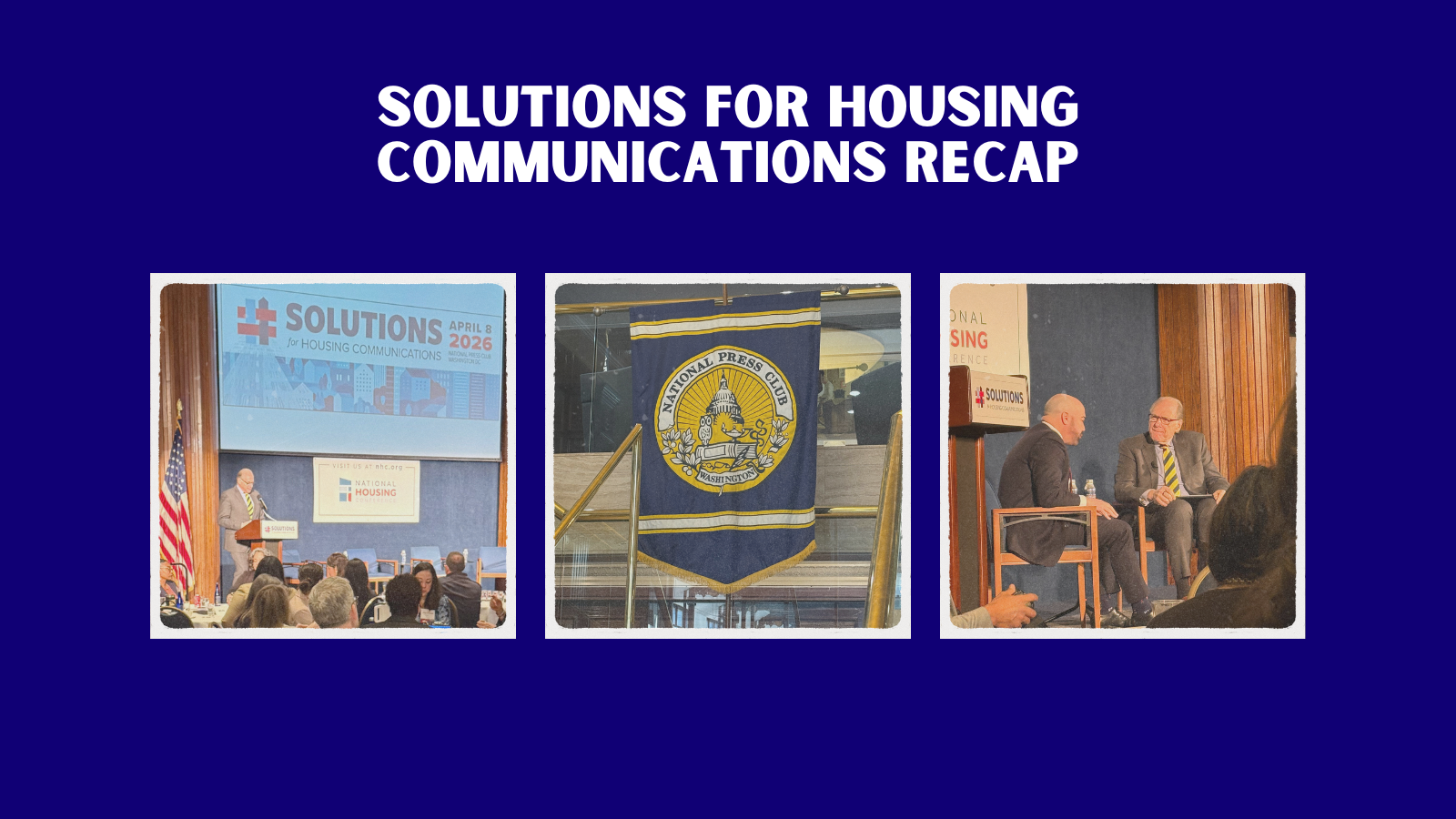
Earlier this month, HAND attended the National Housing Conference Solutions for Housing Communications in Washington, D.C., a national gathering focused on how housing is being discussed, framed, and communicated across the country.
The event brought together federal officials, housing advocates, reporters, developers, researchers, and communicators to talk less about housing construction itself and more about the stories, language, and narratives shaping public understanding of housing issues today.
One thing became very clear throughout the day: housing is no longer being treated as a niche issue. It is increasingly connected to conversations around workforce, economic stability, education, transportation, aging, health, and community development. The way people talk about housing, and the way the public understands it, directly impacts what policies gain traction and what solutions move forward.
Housing Communication Is Shifting
Several sessions focused on the challenge of making housing understandable to people outside the industry.
Speakers emphasized that housing conversations often become too technical, too policy-heavy, or too disconnected from everyday life. The strongest messaging centered around helping people understand how housing impacts stability, opportunity, commute times, education, caregiving, and quality of life.
There was also a major focus on storytelling and lived experience. Reporters on the media panel noted that real stories and real people are often what make housing issues resonate publicly. Data matters, but speakers repeatedly stressed that data alone is not enough without context people can connect to.
One example shared during the conference was that nearly one in four community college students in California is experiencing homelessness. The point was not just the statistic itself, but how housing instability is showing up in places many people may not expect.
Federal Messaging and Fair Housing
One of the most talked-about sessions of the day was the fireside chat with Craig Trainor.
Trainor outlined the current direction of fair housing enforcement at HUD, repeatedly referencing “foundational constitutional principles,” “equal before the law,” and “all men are created equal.”
His remarks emphasized:
- intentional discrimination
- clearly demonstrated harm
- individual complaints and case-based enforcement
He strongly pushed back on broader enforcement approaches like disparate impact, referring to them as “pernicious,” “weaponized,” and based on “phantom discrimination.” He also stated that FHEO is “not a social justice NGO” and should not be involved in what he described as “ideological adventures.”
A major takeaway from the session was that the model described was largely reactive. Enforcement was framed around responding to specific complaints where harm can be proven, with far less discussion around proactive enforcement, identifying patterns, or addressing systemic issues before harm occurs.
At the same time, the communication style itself felt familiar. Much of the messaging focused on fairness, simplicity, and “real people,” themes commonly used across housing communications broadly. The difference was in how those tools were being applied and how narrowly discrimination was being defined within the discussion.
The American Dream and Self-Sufficiency
The keynote from Scott Turner centered heavily around the idea of the American Dream and housing as a pathway to self-sufficiency and upward mobility.
Turner repeatedly framed housing as:
-
a foundation for stability
-
a tool for independence
-
a pathway toward economic progress
The keynote focused heavily on opportunity, supply, reducing barriers to development, and the role of public-private partnerships. There was also a consistent emphasis on personal responsibility and creating pathways toward self-sufficiency rather than long-term dependence on assistance.
While the session stayed relatively high-level and values-focused, it reinforced how strongly housing is being connected to broader national conversations around economic mobility and community growth.
Housing Is One Connected System
Another major theme throughout the conference was that housing issues are deeply interconnected across generations and demographics.
Speakers discussed:
- older adults struggling to age in place
- students experiencing housing instability
- workforce shortages tied to housing supply
- homelessness as both a housing and systems issue
- barriers created by zoning and limited housing diversity
One speaker described the housing system as “we’re all swimming against the same current,” emphasizing that different housing challenges are often connected to the same underlying supply and affordability issues.
Rather than treating housing conversations separately by age group or population, the conference repeatedly returned to the idea that housing should be communicated as one connected story.
Final Reflection
Across every session, one thing remained consistent:
If people do not understand housing, they will not engage with it.
The conference was less about finding one perfect solution and more about understanding how narratives shape public perception, policy, and momentum. Housing conversations are evolving quickly right now, and so is the language surrounding them.
Understanding those shifts matters.